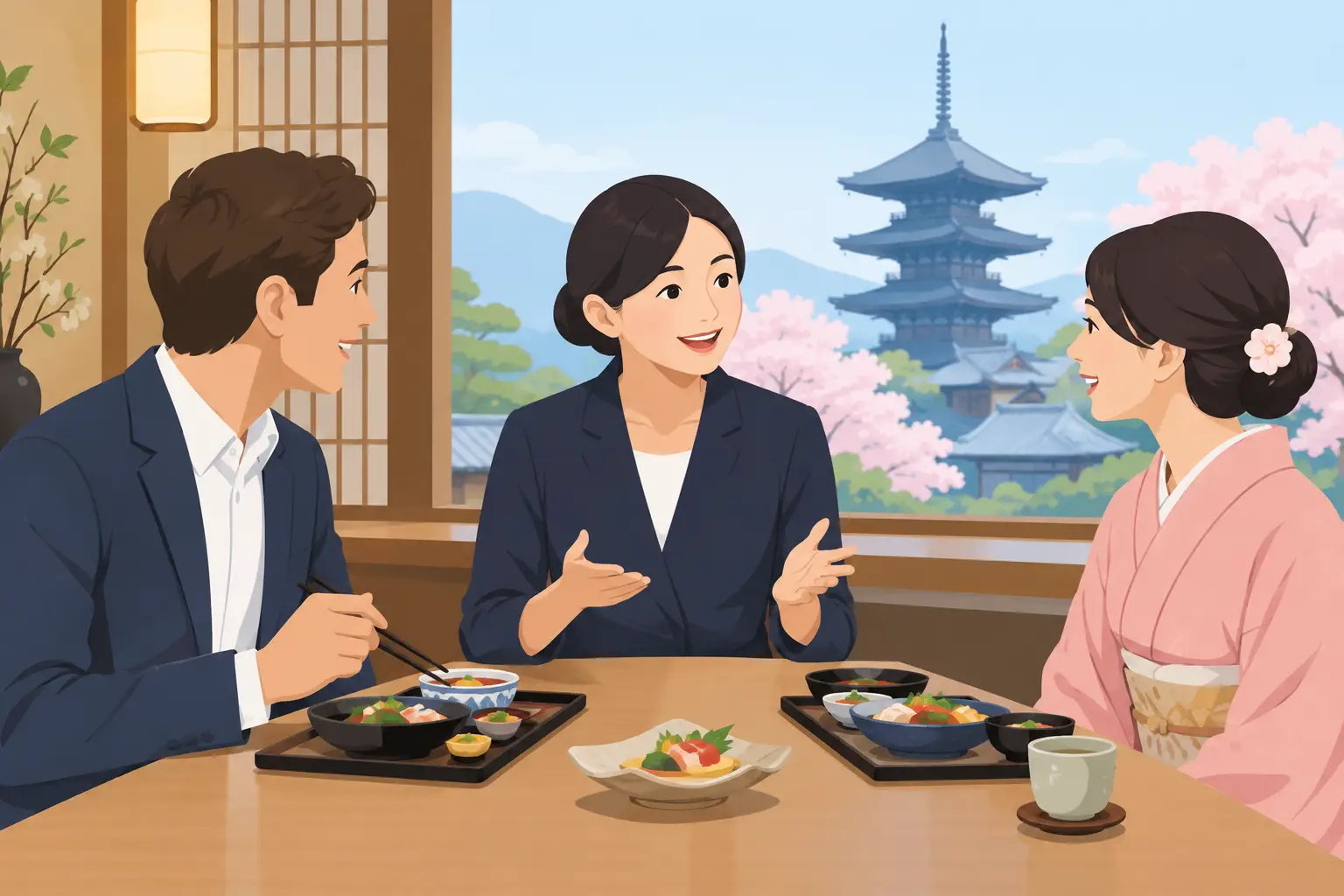
A private room, seasonal Kyoto cuisine, the first notes of shamisen, and the composed presence of a maiko or geisha create a setting unlike an ordinary restaurant reservation. Yet for many overseas guests, the language barrier can leave the most meaningful moments just out of reach. Interpreter assisted dining changes that. It allows conversation, customs, entertainment, and hospitality to be understood as they happen, so the meal feels personal rather than observed from a distance.
For travelers who have come to Kyoto seeking more than photographs of historic streets, this kind of occasion offers a rare Kyoto moment: refined, welcoming, and grounded in living tradition. The interpreter is not simply translating words. They help create the confidence to be present, ask thoughtful questions, and enjoy the occasion with ease.
目次
What Interpreter Assisted Dining Really Offers
A traditional gathering with geisha or maiko is shaped by subtlety. There are greetings, seasonal references, artistic performances, games, and gracious exchanges that carry meaning beyond their literal words. Without language support, guests may still appreciate the beauty of the setting, but much of its warmth and wit can be missed.
With an English-speaking interpreter present, each part of the experience becomes more accessible. Guests can understand introductions, hear context around a dance or musical performance, and join lighthearted ozashiki games without worrying whether they have misunderstood the rules. Questions that might otherwise remain unasked – about kimono, training, daily life, music, or Kyoto customs – can become part of a natural conversation.
This does not turn an elegant gathering into a lecture. The finest interpreter-assisted experiences preserve the rhythm of hospitality. Translation is offered with discretion, allowing the geisha or maiko, the cuisine, and the atmosphere to remain at the center.
Why Language Support Matters at a Geisha Dining Experience
Kyoto’s geisha culture is often described as exclusive, but that word can be misleading. The traditions are highly cultivated, and many private engagements are arranged through long-standing local relationships. For an international visitor, the practical challenge is usually not a lack of interest. It is knowing what is appropriate, how to reserve with confidence, and how to participate respectfully once inside the room.
An interpreter reduces that uncertainty from the start. Guests do not need to rehearse phrases, rely on a translation app during a formal meal, or wonder whether a moment of silence calls for action. They can relax into the occasion. This is particularly valuable for honeymooners, families celebrating a milestone, executive groups, and travelers who have chosen Kyoto for an exceptional cultural memory.
The value is also emotional. A dance becomes more moving when its seasonal imagery is explained. A shamisen performance feels more intimate when guests understand the instrument’s role in the evening. A friendly game becomes a shared laugh, not an unfamiliar ritual happening nearby. The difference is not merely convenience. It is connection.
Translation With Cultural Sensitivity
The best language support does more than move sentences from Japanese into English. It recognizes when a brief explanation will enrich a moment and when restraint is more elegant. It can clarify customs without making guests feel corrected, and it can help guests express genuine appreciation in a way that feels natural.
For example, guests may wish to compliment a performance or ask about a maiko’s hairstyle and kimono. An experienced interpreter can help phrase the question appropriately, then convey the reply with the warmth and nuance it deserves. The exchange remains human, gracious, and unforced.
A More Meaningful Way to Enjoy Kyoto Cuisine
Dining is central to the experience, not an interval between performances. Kyoto-style cuisine often reflects the season through ingredients, presentation, and color. A carefully arranged course may reference early spring, summer rivers, autumn foliage, or the quiet simplicity of winter. Understanding those details brings another layer of pleasure to the table.
Interpreter assisted dining can make this culinary dimension more vivid. Guests may learn about a particular ingredient, the intention behind a serving style, or the etiquette of a shared toast. There is no need to memorize rules before arriving. Attentive guidance lets guests enjoy the meal with confidence while respecting the setting.
That said, the experience should never feel overly managed. Some travelers prefer frequent explanation and lively conversation; others want space to absorb the room, the food, and the performance. A well-curated host team can adjust to the group. For a couple, the tone may be intimate and unhurried. For a private celebration, it may be more animated and participatory.
What to Expect From a Curated Experience
A polished interpreter-assisted meal generally begins with a warm welcome and introductions before guests are seated. As courses are served, the occasion unfolds through conversation and traditional entertainment. Depending on the selected plan, guests may enjoy elegant dance, geisha entertainment games, live shamisen, photographs, and a keepsake that extends the memory beyond the day itself.
The strength of a curated format is clarity. Rather than trying to arrange several unfamiliar elements independently, guests know what their reservation includes, how long it will last, and what kind of participation to expect. This is especially reassuring when a limited Kyoto itinerary leaves little room for uncertainty.
At GEISHAKYOTO, English interpretation is integrated into a premium dining occasion designed to make authentic interaction feel approachable for overseas visitors. The purpose is not to stage a distant version of Kyoto culture, but to create the conditions for a respectful, enjoyable meeting with it.
Questions Worth Asking Before You Reserve
Not every experience described as “geisha dining” offers the same level of access or interpretation. Before reserving, ask whether the geisha or maiko will be present throughout the meal or only briefly, whether interpretation is included for the full experience, and whether performances and games are part of the stated package.
It is equally wise to confirm the duration, private-room arrangement, dietary accommodation process, and photography policy. A premium experience should be transparent about these details. Clear inclusions allow guests to choose a plan that suits their occasion, whether they are celebrating an anniversary, traveling with close friends, or arranging a distinguished client gathering.
Authenticity also deserves a thoughtful definition. An authentic experience is not necessarily one that feels inaccessible or uncomfortable to a foreign guest. In many cases, it is one that respects the performers, the setting, and the traditions while giving visitors a proper way to understand and participate.
Etiquette Is Easier When You Feel at Ease
Guests often worry about making a mistake. The good news is that sincere courtesy matters more than perfect formality. Arrive on time, follow the host’s guidance when entering and taking a seat, and keep your attention on the people and performances in the room. If you would like to take photographs, wait for permission rather than assuming.
An interpreter can quietly guide these moments, but the spirit is simple: be curious, appreciative, and present. Avoid treating geisha and maiko as costumes or attractions. They are accomplished artists and professional hosts whose training includes music, dance, conversation, and the art of making guests feel welcome.
This understanding changes the tone of the meal. Guests are not merely consuming an exclusive experience. They are taking part in a carefully preserved form of Kyoto hospitality.
Is Interpreter Assisted Dining Worth It?
For travelers who only want to see a performance, a theater presentation may be sufficient. For those hoping to share a table, exchange conversation, understand what they are seeing, and carry home a more personal memory, interpretation is often the detail that makes the experience worthwhile.
It depends on what you value. A translated cultural dining experience carries a higher level of planning and service than a standard restaurant meal, and it should be chosen for the depth of access it provides. The reward is not simply having someone explain Japan. It is being able to meet Kyoto on more equal, comfortable terms.
When you sit down to a meal shaped by season, artistry, and gracious conversation, let curiosity set the tone. A few well-chosen questions, a willingness to join the laughter, and the support of a skilled interpreter can turn a beautiful afternoon into a memory that remains distinctly Kyoto long after the journey ends.