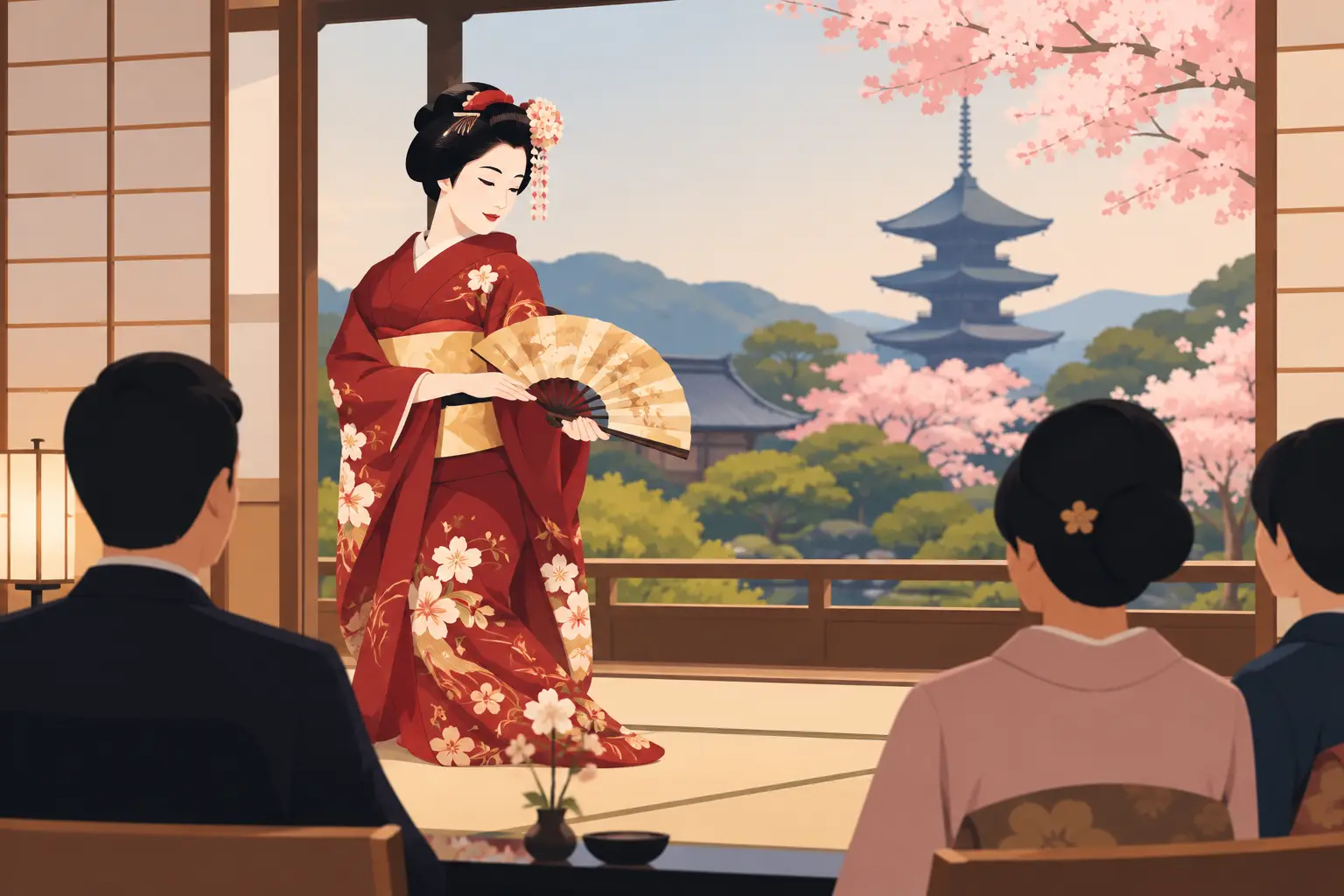
A private geisha event example is best understood not as a staged show, but as a carefully paced afternoon or evening of Kyoto hospitality. The room is intimate. Seasonal cuisine arrives course by course. A maiko or geiko enters in formal dress, performs a dance shaped by centuries of tradition, and then helps turn the occasion into something warmer and more personal through conversation, music, and lighthearted parlor games.
For overseas guests, this is a rare Kyoto moment: genuine cultural entertainment in a setting that feels refined, welcoming, and clear from the first greeting. It is also a format with meaningful variations. The right experience depends on whether you are celebrating a honeymoon, entertaining clients, traveling with family, or seeking a private occasion with close friends.
目次
What a private geisha event can look like
Imagine a private dining room prepared for six guests during a Kyoto visit. The table is set simply and elegantly, with seasonal flowers and carefully chosen tableware. An English-speaking host welcomes the group, explains the flow of the gathering, and removes the uncertainty that can make formal Japanese occasions feel intimidating.
The meal begins with Kyoto-style cuisine. Rather than rushing through courses, guests are invited to notice the season in the ingredients, colors, and presentation. A private event may be arranged around a traditional multi-course meal, or around a refined lunch format for travelers who want an exceptional cultural experience while preserving time for temples, gardens, and shopping later in the day.
After dining begins, a maiko or geiko arrives. In Kyoto, “geiko” is the local term commonly used for a fully trained geisha, while “maiko” refers to an apprentice performer. Both are artists trained in traditional dance, music, etiquette, and conversation. Their presence brings ceremonial beauty to the room, but the experience is not intended to feel distant. With respectful interpretation, guests can understand what they are seeing and participate with confidence.
A private geisha event example, moment by moment
Arrival and a gracious introduction
A polished gathering starts before the performers enter. Your host introduces basic customs, including when to take photographs, how the evening will unfold, and how to address the artists respectfully. There is no need to memorize complicated rules. The purpose of the briefing is to let guests relax and enjoy the occasion without worrying that they will make a cultural mistake.
For a private group, this opening can be tailored to the reason for travel. A couple may be welcomed with a quieter, more romantic atmosphere. A corporate group may prefer a concise introduction that gives colleagues time to connect. Multigenerational families often appreciate added context that makes the artistry meaningful for every age.
Kyoto dining with a sense of season
The dining portion is more than a meal placed beside a performance. Kyoto cuisine is part of the cultural setting. Depending on the venue and season, guests might encounter delicate tofu, grilled fish, mountain vegetables, rice, soup, and artfully composed small dishes that honor the ingredients at their peak.
This is where a curated experience has particular value. A quality host considers pacing, dietary requests, private-room comfort, and interpretation alongside the menu. For guests unfamiliar with formal Japanese dining, a few gentle explanations can make the meal feel accessible without turning it into a lecture.
Traditional dance and live musical artistry
The performance creates the stillest, most memorable part of the occasion. A dance may appear understated at first, especially to viewers accustomed to large theatrical productions. Its power lies in control: the angle of a fan, the measured movement of a sleeve, the expression held for a moment longer than expected.
At a higher level of programming, live shamisen adds another dimension. The three-stringed instrument has a striking, percussive sound that carries beautifully through an intimate room. Seeing music and dance presented at close range reveals details that can be lost in a large venue.
A private event is particularly suited to guests who value this proximity. There is time to observe, ask considered questions through an interpreter, and appreciate the discipline behind what may look effortless.
Ozashiki games and shared laughter
After the formal performance, the atmosphere often becomes more relaxed. Traditional ozashiki games are social games historically enjoyed at geiko entertainment gatherings. They are playful, rhythmic, and easy to join once the rules are explained.
This portion is frequently the surprise highlight for international guests. It replaces the assumption that a geisha experience must be solemn or untouchable with something much more human: laughter around the table, friendly competition, and a genuine sense of connection. The artists remain highly skilled professionals, yet the mood can be wonderfully informal within the boundaries of good etiquette.
Not every private event needs an extended game session. For a couple, a shorter game and more time for photographs may feel ideal. For a group of friends or executive guests, games can become the natural center of the gathering. A well-designed itinerary leaves room to shape the balance.
Photographs and a lasting keepsake
A private setting offers an opportunity for photographs that feels considered rather than rushed. Guests may take individual or group photos with the maiko or geiko at an appropriate point in the program. Your host can guide positioning and timing so the images feel elegant and respectful.
Some experiences also include a small souvenir. It is a thoughtful detail, but the greater keepsake is the story attached to it: the sound of shamisen, the quiet precision of the dance, the warmth of the games, and the realization that Kyoto’s living traditions are not confined to museums.
What makes the experience genuinely private
“Private” can mean different things, so it is worth asking direct questions before reserving. In the most exclusive format, your party has its own room, dedicated performers, host, and schedule. This allows the experience to move at your pace, with the full attention of the artists focused on your group.
A semi-private arrangement may offer a beautiful room and excellent entertainment but share certain elements with other guests. This can be a more practical choice for travelers with limited availability or a smaller budget. It may still be memorable, but it does not offer the same freedom for conversation, pacing, or celebration.
The number of performers also matters. One maiko or geiko can create an intimate and personal event. Two artists can bring richer musical interplay, more energy during games, and easier engagement for larger groups. The best choice is not always the largest production. It is the one that suits your party size and purpose.
Etiquette that lets you feel at ease
Guests do not need prior knowledge to enjoy a private geisha event, but a few principles show appreciation. Arrive on time, follow guidance on photography, and allow the interpreter or host to lead introductions. Avoid treating the artists as costumes or props. They are accomplished cultural professionals whose work reflects years of training.
Conversation is welcome when it is guided respectfully. Ask about music, dance, seasonal customs, or daily training. Avoid overly personal questions. If a game involves a small penalty such as a sip of a beverage, participation should always feel comfortable and optional.
Dress need not be formal Japanese attire unless the occasion specifies it. Smart, polished clothing is usually appropriate. For a special anniversary, proposal trip, or client event, elevated evening wear complements the setting beautifully.
Choosing the right occasion and format
A private geisha event is especially meaningful when it has a purpose. Honeymooners often choose it for the romance of a private Kyoto evening. Families may use it to create one shared experience that appeals to different generations. Private travel groups value the ease of a planned cultural occasion, while companies appreciate an elegant way to host international guests.
Lunch is often ideal for travelers who prefer daylight schedules, shorter durations, and a focused cultural highlight. An evening event can feel more ceremonial and celebratory, particularly when paired with a leisurely dinner. Neither is inherently better. The decision comes down to your itinerary, energy level, group dynamics, and the atmosphere you hope to create.
For travelers seeking trusted access, a curated format such as GEISHAKYOTO brings together dining, performance, games, photographs, and English-language hosting in one reservation. That structure is not merely convenient. It gives guests the confidence to be fully present for an art form that deserves their attention.
A memorable private gathering should leave you with more than beautiful photographs. It should give you a feeling of having been welcomed into Kyoto’s cultural rhythm, even if only for a few exceptional hours.