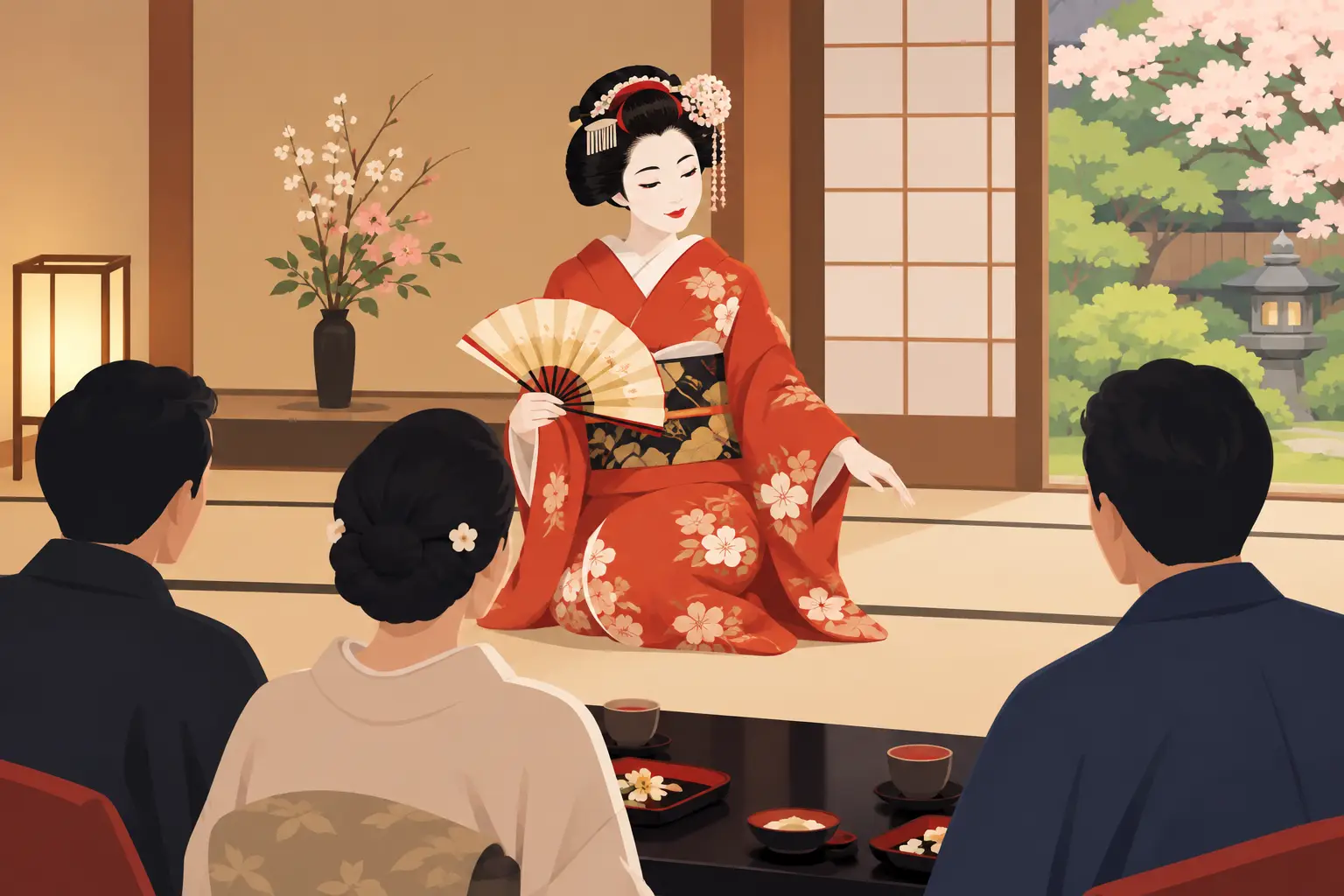
A Kyoto ozashiki is not a stage show where guests simply watch from a distance. It is an intimate evening of hospitality, artistry, conversation, and shared enjoyment. Understanding how geisha entertain guests makes the experience far more meaningful: every dance, musical phrase, game, and gracious exchange is part of a living tradition shaped by Kyoto’s refined culture.
For many international visitors, this world can seem private or difficult to access. In its proper setting, however, an ozashiki is designed to put guests at ease. With thoughtful hosting, clear interpretation, and respect for local customs, it becomes a rare Kyoto moment that feels both elegant and genuinely welcoming.
目次
- First, a Kyoto distinction: geiko and maiko
- How geisha entertain guests through performance
- Conversation is part of the entertainment
- The games that bring the room together
- Dining, seasonality, and the setting
- What guests should do, and what they need not worry about
- A more accessible way to experience Kyoto tradition
First, a Kyoto distinction: geiko and maiko
In Kyoto, the term geiko is used for an accomplished professional entertainer whom visitors outside Japan often call a geisha. A maiko is an apprentice geiko, recognized by her youthful hairstyle, elaborate kimono, and distinctive makeup. Both train extensively in traditional arts and social hospitality.
Their work is often misunderstood. Geiko and maiko are not defined by mystery or costume. They are highly trained artists and hosts who preserve dance, music, seasonal customs, and the polished conversational culture of Kyoto’s hanamachi, or geisha districts.
An ozashiki may feature a maiko, a geiko, or both. The atmosphere varies according to the occasion, group size, venue, and performers, but the purpose remains consistent: to create a memorable gathering through skillful, attentive hospitality.
How geisha entertain guests through performance
Traditional dance is one of the most recognizable parts of a geiko or maiko experience. Performed in a composed tatami-room setting, Kyoto-style dance is subtle rather than theatrical in the Western sense. A turn of the wrist, the angle of a fan, or a pause in stillness can convey a season, a love story, a journey, or a scene from classical poetry.
The beauty lies in restraint. Guests may see a dance inspired by cherry blossoms, autumn maple leaves, flowing water, or the changing emotions of a traditional song. The performer’s kimono, fan, and movements all contribute to the story. Rather than trying to follow every reference, it is best to watch closely and allow the atmosphere to unfold.
Music gives the evening another dimension. The shamisen, a three-stringed instrument with a bright, resonant voice, is central to many Kyoto entertainments. A higher-level gathering may include live shamisen accompaniment, allowing guests to hear the rhythm and tonal detail that support the dance. Singing may also be part of the program, depending on the artists and the format of the occasion.
These performances are short by design. They are not intended to fill an entire evening as a concert would. Instead, they create a graceful rhythm between dining, conversation, games, and photographs.
The art behind a seemingly effortless performance
A few minutes of dance can represent years of instruction. Geiko and maiko study dance, shamisen, song, tea service, etiquette, Kyoto dialect, and the practical art of reading a room. Their performance is precise, yet it should never feel stiff.
This is one reason an authentic encounter carries such presence. Guests are seeing a tradition performed by people who have dedicated their professional lives to it, not a simplified reenactment created for sightseeing.
Conversation is part of the entertainment
The liveliest moments of an ozashiki often happen between performances. Geiko and maiko are accomplished conversationalists. They may ask where guests are visiting from, comment on the season, share light observations about Kyoto, or respond warmly to the energy of the group.
This should not be mistaken for a formal lecture on history. The exchange is meant to be social, responsive, and enjoyable. A skilled host knows how to include quieter guests without putting anyone on the spot and how to bring warmth to a table with different ages, cultures, and personalities.
For English-speaking visitors, interpretation is especially valuable. It allows the humor, nuances, and introductions to be understood without disrupting the natural flow of the gathering. It also gives guests the confidence to participate without worrying about the right Japanese phrase.
Questions are welcome when asked respectfully. Many guests are curious about training, kimono, hairstyles, or daily life in Kyoto. The best questions come from sincere interest rather than assumptions. Avoid asking overly personal questions, requesting private contact details, or treating the performers as a novelty. Courtesy is the foundation of the experience.
The games that bring the room together
Geisha entertainment is not entirely formal. Traditional drinking games are a cherished part of ozashiki culture, bringing laughter and friendly competition to the room. They are simple enough to join without Japanese language ability, yet they carry the charm of customs passed through generations.
One well-known example is konpira funefune, a hand game played to a rhythmic song. Players alternate placing or removing an object while following the beat, and the pace quickly becomes more challenging than it first appears. Other games may involve clapping patterns, gestures, or quick reactions.
The point is not to win. These games dissolve the distance between guest and performer, creating a shared memory rather than a passive viewing experience. A good host will explain the rules, encourage participation, and make sure nobody feels pressured. If you prefer to observe, that is perfectly acceptable; if you join in, expect a room full of smiles.
Alcohol is sometimes part of a traditional ozashiki, but it is never the essence of the occasion. Premium daytime and lunch experiences can offer the same cultural richness through cuisine, performance, music, and games in a more relaxed format. This can be particularly appealing for families, couples, and travelers with a full Kyoto itinerary.
Dining, seasonality, and the setting
The setting matters as much as the program. Traditionally, geiko and maiko entertain in refined Japanese restaurants known as ryotei, where hospitality is expressed through architecture, tableware, service, and seasonal cuisine. A carefully prepared Kyoto meal establishes the pace of the experience before the first dance begins.
Seasonality is central to Japanese hospitality. You may notice a motif repeated in the food, flowers, sweets, fan designs, or performance selection: spring blossoms, summer coolness, moon viewing, autumn foliage, or winter pine. These details are not decoration alone. They are a way of honoring the present moment.
This is why no two gatherings feel exactly alike. A private celebration, executive dinner, honeymoon occasion, or small group lunch will each have a different energy. The number of performers, duration of the entertainment, musical elements, and photo opportunities can also vary by package.
What guests should do, and what they need not worry about
Visitors do not need to arrive with expert knowledge of Japanese etiquette. The most valuable qualities are punctuality, curiosity, and consideration. Follow the guidance of your host, wait to be invited before taking photographs, and be mindful that some rooms have seating customs or require shoes to be removed.
Dress smartly for the occasion. A jacket or elegant dress is appropriate for many premium venues, though strict formalwear is not always necessary. If you have dietary requirements, mobility needs, or a special celebration in mind, communicate them when reserving so the experience can be arranged with care.
It is also wise to set realistic expectations. An authentic geiko or maiko gathering is intimate, not a theme-park spectacle. The magic is found in the closeness of the interaction: a dance performed only a few feet away, the sound of live shamisen in a quiet room, a game shared across the table, and a portrait that preserves the occasion.
A more accessible way to experience Kyoto tradition
Historically, entry to the most private ozashiki settings often depended on introductions and established relationships. That tradition still deserves respect. For overseas visitors, a professionally curated experience offers a thoughtful alternative: real artists, an appropriate venue, transparent inclusions, and English support that removes uncertainty without diluting the cultural setting.
At GEISHAKYOTO, structured Kyoto dining experiences bring together seasonal cuisine, authentic entertainment, traditional games, photo opportunities, and interpretation in a format designed for international guests. The result is not simply an item on a Kyoto itinerary, but an occasion with the warmth and polish that such a tradition deserves.
When you enter the room, leave room in your schedule and your attention for the details. The most lasting part of the evening may not be the photograph or even the performance. It may be the quiet moment when music, hospitality, and Kyoto’s seasonal beauty come together at one table.