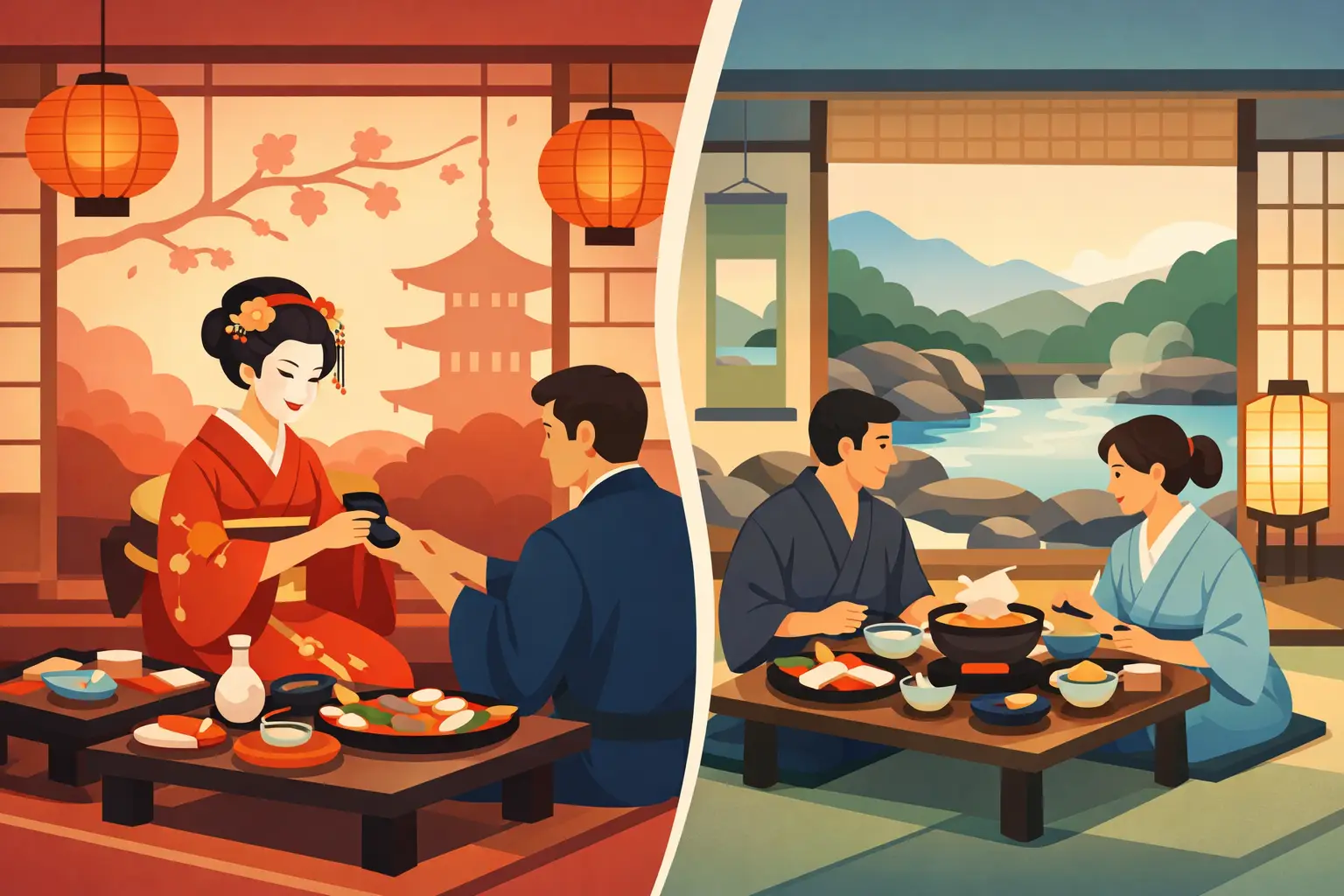
A Kyoto dinner can be exquisite without being the same kind of experience. The choice between a geisha banquet versus ryokan dinner is less about which meal is more elegant and more about what you hope to remember: an evening of personal cultural exchange and performance, or the quiet pleasure of traditional hospitality at your own pace.
Both can feature meticulous seasonal cuisine, gracious service, and the sense that Kyoto takes dining seriously. Yet they create very different atmospheres. For travelers planning one exceptional meal – perhaps for a honeymoon, anniversary, private group, or first visit to Japan – knowing the distinction helps turn a beautiful reservation into the right one.
目次
Geisha Banquet Versus Ryokan Dinner: The Essential Difference
A geisha banquet, often associated with an ozashiki-style gathering, centers on living entertainment and conversation. In Kyoto, you may hear the terms geiko for a fully trained entertainer and maiko for an apprentice. Guests dine while enjoying traditional dance, shamisen music, refined drinking games, and the poised social artistry for which Kyoto’s hanamachi districts are known.
The meal matters, but it is one element of a hosted cultural occasion. The most memorable moments often happen between courses: watching the precise movement of a dance, joining a lighthearted game with guidance, or having a conversation through an interpreter that makes a centuries-old world feel warmly present.
A ryokan dinner is centered on the hospitality of the inn. It is usually a multi-course kaiseki-style meal served in a private room, dining room, or guest room, depending on the property and plan. The experience is intimate and restful. Courses arrive in a considered sequence, often reflecting the season through local ingredients, ceramics, garnishes, and preparation.
Neither is inherently superior. A geisha banquet is a cultural event with dining at its heart. A ryokan dinner is a dining ritual within an overnight stay. The better choice depends on whether your priority is interaction or retreat.
Choose a Geisha Banquet for Cultural Connection
For many overseas visitors, meeting real geiko or maiko is one of Kyoto’s most sought-after yet difficult-to-arrange experiences. The traditional world is private by nature. Independent access can involve personal introductions, Japanese-language coordination, strict expectations, and uncertainty about what is actually included.
A thoughtfully arranged geisha banquet removes those barriers while preserving the dignity of the occasion. Rather than simply observing from a distance, guests can experience the artistry in a setting designed for conversation, participation, and understanding. English interpretation is particularly valuable here. It gives context to the performance, clarifies etiquette, and allows the exchange to feel natural rather than formal or confusing.
This is the right choice if you want your meal to carry a sense of occasion. It suits couples celebrating something meaningful, friends traveling together, executives hosting valued guests, and families with adult children who want more than a photograph outside Gion. A well-curated gathering can include Kyoto-style cuisine, a traditional dance performance, geisha entertainment games, photographs, and, in elevated plans, live shamisen.
There is also a practical advantage: a structured banquet makes the experience approachable. You do not need to know the rules of a traditional ozashiki in advance. Your host and interpreter guide the flow, so you can be present for the rare Kyoto moment rather than worrying about whether you are doing everything correctly.
What the atmosphere feels like
Expect elegance, but not stiffness. The most successful geisha banquets balance formal beauty with warmth. A dance may be quietly captivating; the games that follow can bring unexpected laughter. This contrast is part of the art. Geiko and maiko are not simply performers. Their training includes music, dance, conversation, timing, and the ability to make guests feel welcomed.
For travelers who value authentic access, this human dimension is the difference. You are not only looking at Kyoto tradition. You are sharing a table with it.
Choose a Ryokan Dinner for Privacy and Stillness
A ryokan dinner is ideal when your priority is restoration. After a day of temples, gardens, shopping streets, and train schedules, returning to a carefully prepared meal and a peaceful room can feel deeply luxurious. If your stay includes an onsen, the rhythm is especially appealing: bathe, change into yukata, and settle in for dinner without needing to leave the property.
The culinary focus is often more pronounced than at a banquet. A fine ryokan may present a progression of small seasonal dishes, from a delicate appetizer to sashimi, grilled fish, simmered vegetables, soup, rice, and dessert. The details reward unhurried attention. You may notice the temperature of the serving ware, the aroma of dashi, or the way an ingredient marks a particular moment in the Kyoto calendar.
Privacy is another strength. A ryokan dinner can be especially appealing for honeymooners, travelers who prefer a quiet evening, or anyone seeking time away from group activities. There is no expectation to participate, converse through interpretation, or follow entertainment. The luxury lies in being looked after with discretion.
That said, the experience can be more self-contained. Even at an exceptional ryokan, you are unlikely to have direct interaction with geiko or maiko unless the property has arranged a separate entertainment program. If a personal encounter with Kyoto’s traditional performing arts is central to your trip, a ryokan dinner alone may leave that wish unanswered.
Compare the Experience Before You Book
The cuisine at both can be excellent, but the emphasis differs. A ryokan is generally the stronger choice for guests who want a long, contemplative kaiseki meal as the evening’s main event. A geisha banquet is best for those who see cuisine as part of a broader cultural program, where performance and conversation are equally meaningful.
Consider timing as well. Many ryokan dinners are tied to the schedule of your overnight stay and take place in the evening. Curated geisha dining experiences may be offered at lunch or at selected times, which can be useful for travelers with limited nights in Kyoto. A daytime banquet also leaves room for an evening stroll through Gion or a relaxed return to your hotel.
Group dynamics matter. A quiet ryokan meal is naturally suited to one or two people. It can work beautifully for a family or small group, but the experience remains private and inward-looking. A geisha banquet often becomes more vivid when shared. The entertainment games, photos, and shared response to the performances give groups a natural way to connect.
Budget should be considered with clarity rather than hesitation. Premium ryokan stays often combine accommodation, dinner, breakfast, and sometimes bathing facilities, so their value is tied to the full overnight experience. A geisha banquet is a distinct cultural investment. Its price reflects the presence of trained artists, performance, interpretation, coordination, cuisine, and a setting that would otherwise be difficult for international guests to access.
Etiquette Is Easier Than It Looks
Both experiences ask for appreciation, not perfection. At a ryokan, arrive on time, follow the staff’s guidance, and let the meal unfold at its intended pace. If you have dietary restrictions, communicate them well before arrival, as seasonal menus are planned carefully.
At a geisha banquet, polished attire is appropriate, though you do not need formal Japanese clothing unless stated. Listen to the host or interpreter, ask respectful questions, and treat photography according to the guidance provided. Do not assume that every moment is available for filming or that personal questions are suitable. A curated experience will make these boundaries clear without making the evening feel intimidating.
Most of all, avoid treating geiko and maiko as costumes or sightseeing props. Their work represents years of disciplined artistic training. When guests approach the occasion with curiosity and courtesy, the atmosphere becomes more relaxed and rewarding for everyone.
Can You Enjoy Both on One Kyoto Trip?
For travelers staying several nights, the two experiences complement each other remarkably well. Reserve a ryokan for the night when you want to slow down and absorb Kyoto through its culinary seasons. Choose a geisha banquet on another day when you want to enter the social and artistic traditions that are rarely available through ordinary restaurant reservations.
If you have time for only one, let the question be simple. Do you want to savor Kyoto in private, course by course? Choose the ryokan. Do you want to share a table with its music, dance, conversation, and living traditions? Choose the banquet.
GEISHAKYOTO is designed for guests who want the latter in a polished, English-accessible format, with clear inclusions and the confidence of a carefully hosted occasion. Reserve early when this experience is a priority, particularly during cherry blossom season, autumn foliage, and major holiday periods.
The most meaningful Kyoto meal is not always the one with the most courses or the grandest room. It is the one that gives your journey the memory you came hoping to find.