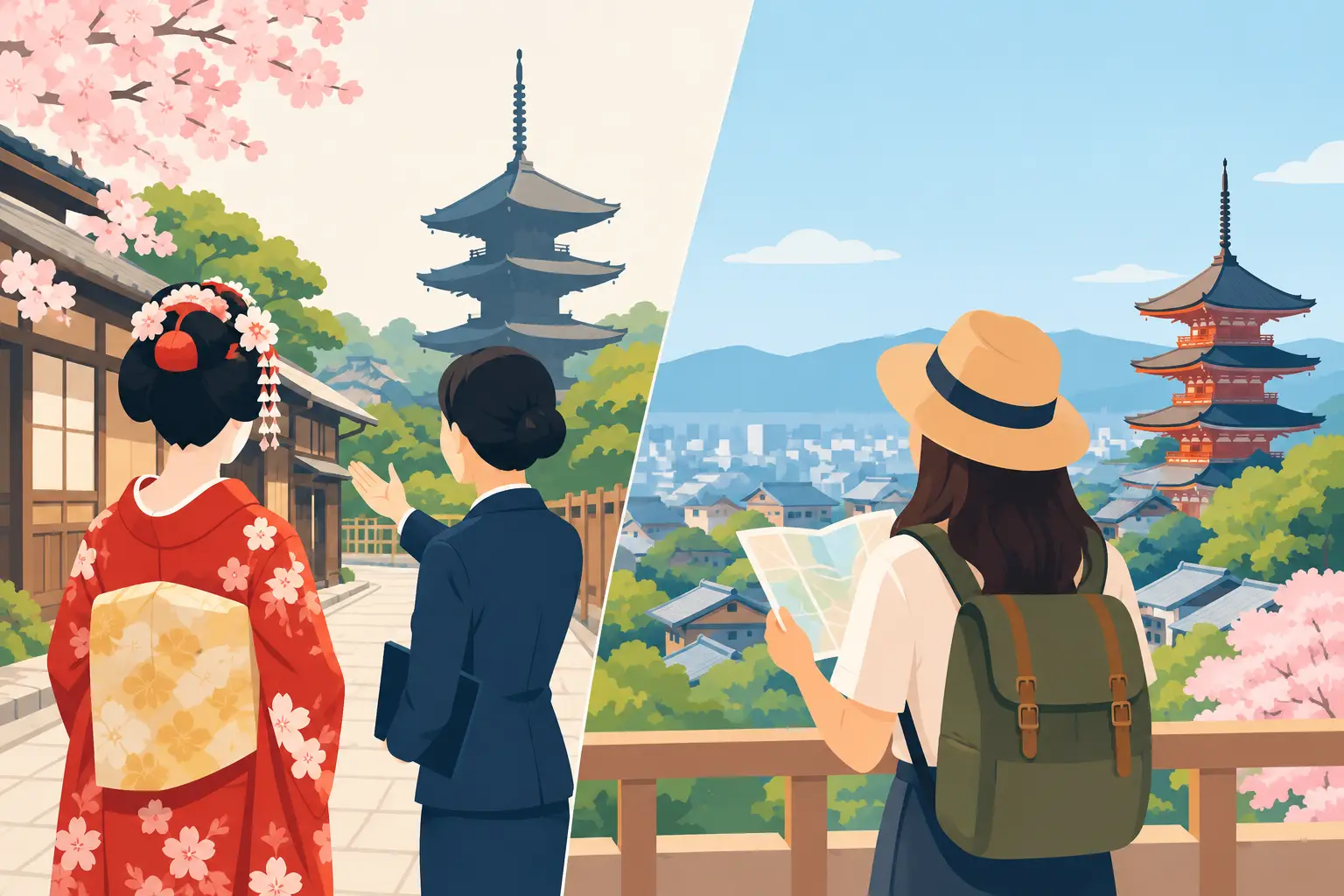
A private Kyoto dinner can look effortless from the outside: a discreet entrance, seasonal dishes arriving in perfect rhythm, and a maiko or geiko performing only a few feet away. Yet the guided geisha event versus self-planned decision determines whether that rare moment feels gracefully hosted or uncertain from the first inquiry onward.
For travelers who value meaningful access to Kyoto tradition, this is not simply a question of itinerary style. It is a choice between arranging an evening around a culture that is deliberately private and entering it through a trusted, carefully prepared setting. Both approaches have merit. The right choice depends on how much time, flexibility, local knowledge, and comfort with ambiguity you bring to Kyoto.
目次
- Why a Geisha Experience Is Difficult to Arrange Independently
- Guided Geisha Event Versus Self-Planned: The Essential Difference
- What You Gain From a Curated Experience
- The Etiquette Advantage Is More Meaningful Than It Sounds
- When Self-Planning May Be the Better Choice
- How to Choose for Your Kyoto Visit
Why a Geisha Experience Is Difficult to Arrange Independently
Kyoto’s geiko and maiko culture is not a performance product designed for walk-in tourism. In Kyoto, the term geiko is commonly used where international visitors may say geisha, while maiko are apprentice entertainers. Their world is centered in the historic hanamachi districts, where relationships, introductions, schedules, and long-standing customs matter.
A self-planned evening may begin with the hope of booking an ochaya, or traditional entertainment house, directly. In practice, many establishments work through existing patrons, introductions, or Japanese-speaking intermediaries. Availability can be limited, pricing may not be presented in a familiar format, and arrangements often require more than a single reservation request.
Even when a visitor secures a private arrangement, the experience can demand confidence. You may need to confirm the venue, understand what is included, communicate dietary requirements in Japanese, arrange transportation, and know how the evening is expected to unfold. None of this makes independent planning impossible. It simply means the polished, effortless version of the evening may require considerable work behind the scenes.
Guided Geisha Event Versus Self-Planned: The Essential Difference
A guided event is designed to remove the invisible barriers without reducing the cultural substance. Rather than asking guests to find the right door, interpret unfamiliar etiquette, and hope the details align, it brings dining, performance, entertainment, and interpretation into one intentional occasion.
At its best, a guided experience offers more than a dance viewed from across a restaurant. Guests enjoy a refined Kyoto meal, see traditional dance at close range, hear the musical atmosphere of shamisen where included, and take part in the lighthearted ozashiki games that reveal a more personal side of geiko and maiko hospitality. English-speaking interpretation gives context to what you are seeing and helps conversation feel natural rather than formal or strained.
A self-planned event offers a different form of luxury: independence. Travelers with trusted local contacts, fluent Japanese, ample time, and a genuine interest in managing the details may prefer to shape every element themselves. They may choose a particular restaurant, neighborhood, or pace for the evening. For the right traveler, the planning itself can be part of the pleasure.
The trade-off is predictability. With a guided format, the key elements are clear before arrival. With a self-planned evening, even a beautifully arranged reservation can leave more variables in the hands of intermediaries, schedules, and local customs.
What You Gain From a Curated Experience
The strongest reason to choose a guided geisha event is not convenience alone. It is the ability to be fully present.
When the meal, entertainment, interpretation, and guest experience have been thoughtfully coordinated, there is room to notice the details: the movement of a sleeve during a dance, the shifting tone of the shamisen, the seasonal character of the cuisine, and the warmth behind a game shared at the table. You are not checking messages to confirm a taxi, wondering whether a tip is expected, or trying to translate a question at the exact moment the room comes alive.
Clarity also matters for special occasions. A honeymoon couple, a multigenerational family, or executives hosting important guests often do not want their most anticipated Kyoto evening to depend on unfamiliar logistics. A structured experience establishes the duration, inclusions, setting, and level of support in advance. That assurance is part of premium hospitality.
Photography is another practical consideration. In an appropriate, hosted setting, guests may have a clear opportunity to create a keepsake rather than relying on hurried or uncertain photographs. A professional-style photo moment, a small souvenir, and an elegant meal give the experience a lasting shape beyond a single performance.
GEISHAKYOTO presents this kind of occasion as a complete cultural lunch experience, combining Kyoto dining with authentic geiko or maiko entertainment, games, photo opportunities, and English-speaking support. For guests whose Kyoto time is limited, a daytime format can also preserve the evening for a stroll through Gion, a private dinner, or a quiet return to the hotel.
The Etiquette Advantage Is More Meaningful Than It Sounds
Many international guests worry about making a mistake around geiko and maiko. Respect is appreciated, but perfection is not expected. The real challenge is that etiquette is often conveyed through context rather than a written set of rules.
A host or interpreter can explain when photographs are welcome, how games are played, what a performance represents, and how to engage naturally. This avoids the two extremes that can diminish a meaningful encounter: treating the occasion as a distant museum display or becoming overly casual in a setting rooted in living tradition.
Independent guests can prepare well, of course. Dress thoughtfully, arrive on time, follow the lead of the host, and ask before taking photographs. Avoid assumptions based on films or social media. A geiko or maiko is a trained professional artist, and the most rewarding interaction comes from approaching the occasion with interest, courtesy, and an open mind.
When Self-Planning May Be the Better Choice
Self-planning deserves consideration when you have an established connection in Kyoto or a Japanese-speaking concierge who can arrange an appropriate private evening. It can also suit repeat visitors who already understand the city and want to pursue a highly specific restaurant, neighborhood, or relationship-led experience.
It may be less suitable for a first visit with only a few days in Kyoto. In that situation, the time spent researching, communicating, confirming, and second-guessing can outweigh the benefit of independence. A self-planned experience is not necessarily more authentic simply because it is less structured. Authenticity comes from respectful access, skilled artistry, and a setting that honors the tradition, whether it is arranged privately or through a trusted curator.
Budget also deserves an honest comparison. An independent arrangement may appear flexible at first, but final costs can be difficult to estimate once entertainment fees, dining, interpretation, transportation, and service are considered. A transparent guided package is often easier to evaluate because guests know what the experience includes before they commit.
How to Choose for Your Kyoto Visit
Choose a guided event if you want cultural depth without logistical uncertainty, if language support will help you relax, or if the occasion is important enough to merit a carefully orchestrated experience. It is particularly well suited to first-time visitors, couples celebrating a milestone, private groups, and travelers who prefer quality time over extensive planning.
Choose self-planning if you have the language ability, trusted access, and desire to shape the evening independently. Be prepared to be patient and flexible. The most exclusive arrangements are often built through relationships, not instant confirmation.
Whichever path you choose, set aside the idea of simply checking geisha culture off a Kyoto list. The meaningful memory is not the photograph alone. It is the quiet attention of the room, the artistry in front of you, and the rare feeling of being welcomed into a tradition that Kyoto has protected with extraordinary care.