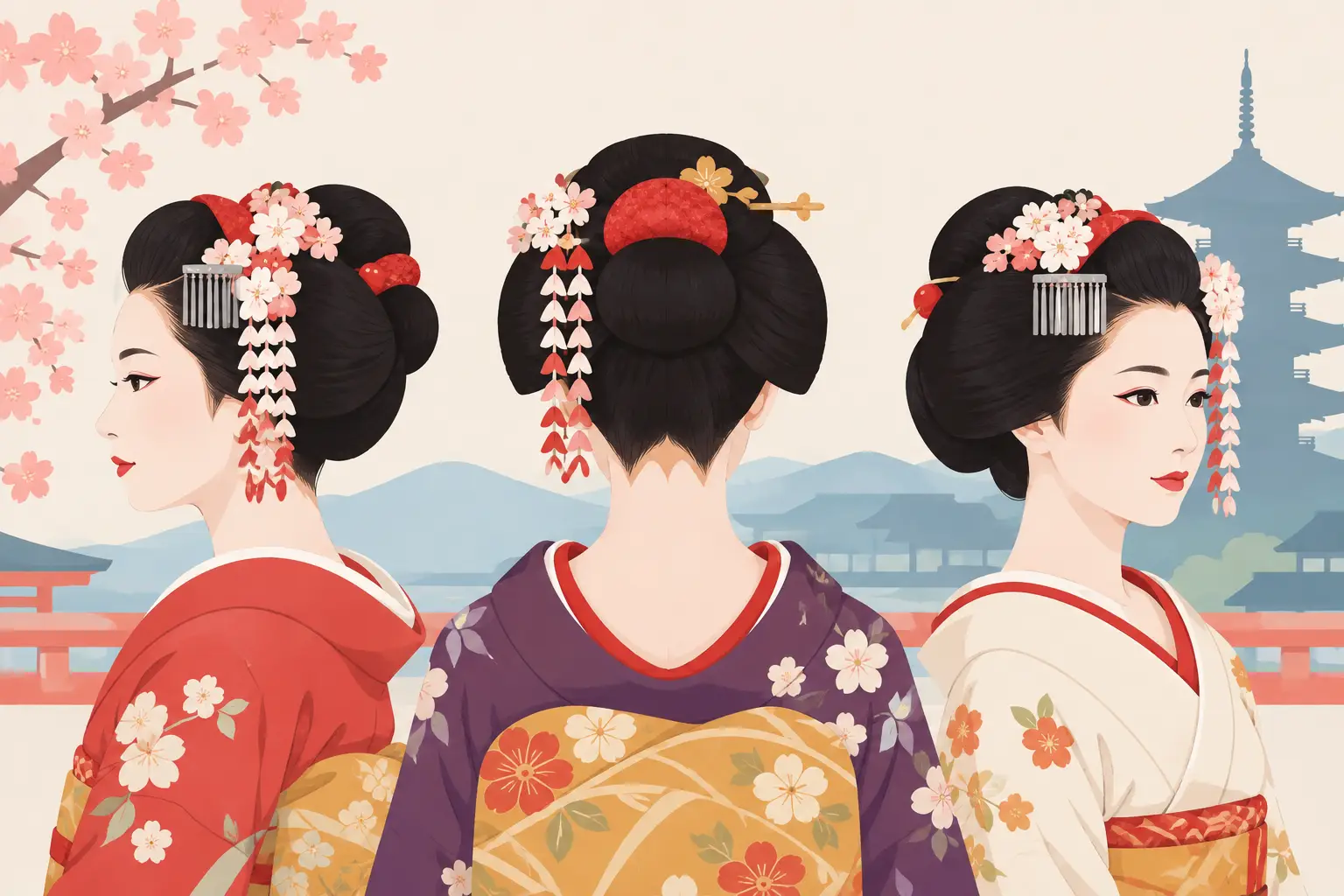
A maiko’s hairstyle is not simply an exquisite finishing touch. In Kyoto’s flower districts, it can quietly signal her progress through apprenticeship, the season, and sometimes an important moment in her professional life. Learning how to identify maiko hairstyles adds a more informed layer to an encounter that might otherwise pass in an instant.
For visitors, the pleasure lies in noticing these details with humility. A hairstyle offers clues, not an invitation to make assumptions about a young woman’s age, schedule, or private life. Kyoto tradition is precise, but it is also living, personal, and shaped by each district’s customs.
目次
How to Identify Maiko Hairstyles by Their Shape
A maiko is an apprentice entertainer in Kyoto’s traditional arts districts, known as hanamachi. Her appearance is carefully composed: formal kimono, a long obi, white makeup for formal occasions, and an elaborate hairstyle dressed with kanzashi hair ornaments. While the kimono may catch the eye first, the hair often reveals the more subtle story.
The most useful distinction is between a maiko’s coiffure and the wigs commonly worn by geiko, the Kyoto term for a fully qualified geisha. Maiko traditionally wear their own hair, shaped with wax into sculptural forms by a specialist hairdresser. The effect can look remarkably polished, yet the hairline often appears softer and more natural than a formal wig. This is a helpful visual cue, not a rule to apply from a distance. Formal events, performances, and individual circumstances can affect what you see.
Wareshinobu: The Early Apprenticeship Style
The wareshinobu is among the most recognizable maiko hairstyles. It is generally associated with a younger maiko in the earlier part of her apprenticeship. Look for a full, rounded silhouette with a prominent central topknot and bright red silk, often called kanoko, woven into the arrangement.
Its abundance is part of its charm. The style is youthful, decorative, and visually rich, with ornaments that emphasize the freshness of a new apprentice’s presence. If you see a maiko with a generously rounded coiffure and vivid red details, wareshinobu may be the style you are observing.
Ofuku: A More Mature Maiko Style
As a maiko gains experience, she commonly transitions to ofuku. This hairstyle usually has a more streamlined, composed profile than wareshinobu. The overall impression is still elegant and ornate, but less overtly youthful.
Visitors sometimes try to read ofuku as an exact measure of seniority. It is better understood as a stage marker rather than a precise timeline. A maiko’s progression is shaped by her house, her training, and local practice. The visual shift matters because it reflects a broader movement toward the poise expected of a future geiko.
Sakkō: A Farewell Hairstyle
Sakkō is especially meaningful because it is traditionally worn near the end of a maiko’s apprenticeship, shortly before her erikae, the ceremony marking her debut as a geiko. Its silhouette is distinctive, often appearing more formal and mature, with a dramatic, carefully structured topknot.
This is not a hairstyle most visitors will encounter casually. When it does appear, it may indicate a significant professional transition. The appropriate response is appreciation rather than intrusion. Avoid asking personal questions or requesting a posed photograph on the street, even when the occasion feels rare.
Seasonal Kanzashi Are Part of the Story
To identify maiko hairstyles well, look beyond the shape of the hair. Kanzashi provide some of the loveliest seasonal signals in Kyoto. These ornaments may include silk flowers, combs, pins, or delicate hanging elements, selected to complement the month, occasion, and level of formality.
In spring, you may notice cherry blossoms, plum blossoms, or other floral motifs. Early summer can bring wisteria, irises, and hydrangea-inspired details. Autumn ornaments often suggest maple leaves or chrysanthemums, while winter designs may be more restrained, using pine, bamboo, plum, or New Year motifs.
Younger maiko are particularly associated with hana kanzashi, cascading silk-flower ornaments that move lightly as they walk. These can be wonderfully expressive, but they should not be treated as a simple calendar. A special performance, festival, or formal engagement may call for a different choice. Think of the ornaments as an artful seasonal language, not a tourist checklist.
Special Styles Appear for Festivals and Milestones
Kyoto’s annual calendar includes occasions when a maiko may wear a hairstyle beyond the familiar wareshinobu and ofuku. Certain festivals, dances, and ceremonial periods have their own visual traditions. Katsuyama, for example, is associated with the Gion Festival season, while other named styles may appear around New Year or major professional milestones.
These looks are fascinating precisely because they are not everyday displays. They often carry histories that are recognizable within a particular hanamachi, rather than across all of Japan. Kyoto has five principal geiko districts, and details can differ between them. The most accurate approach is to enjoy what you see without insisting that every ornament or arrangement must follow one universal code.
Maiko, Geiko, and Transformation Experiences
One reason identification can be difficult is that Kyoto also has transformation experiences, known as henshin, where visitors dress in maiko-inspired attire for photographs. These experiences can be beautifully executed and are a popular way to appreciate the aesthetics of traditional dress. They are not, however, the same as meeting a working maiko.
Rather than relying on one feature, observe the complete presentation. A professional maiko’s dress, hairstyle, manner, and surroundings form part of a practiced world of hospitality and performance. Even then, it is wise not to speculate. A visitor in formal costume, a performer, and a maiko on her way to an engagement may all deserve the same courtesy: space, discretion, and no unwanted attention.
A geiko may also wear a refined wig for formal appearances, often with a more understated overall styling than a maiko. Her kimono, obi, and ornaments are generally more restrained, reflecting professional maturity. Yet costume details are nuanced enough that a quick street-side judgment can easily be wrong.
The Most Respectful Way to Observe
Kyoto’s hanamachi are working neighborhoods, not open-air stages. If you happen to see a maiko or geiko, do not follow her, block her route, touch her kimono or hair ornaments, or ask for a spontaneous photograph. A brief, respectful glance is entirely different from turning a private walk between appointments into a spectacle.
For travelers who want a meaningful introduction, a hosted cultural experience provides a far better setting. You can see the artistry of dress and performance in context, understand the etiquette, and ask thoughtful questions through interpretation without placing pressure on the women who sustain these traditions. At GEISHAKYOTO, this kind of encounter is designed as a refined Kyoto occasion, pairing dining, traditional entertainment, and clear English-language support.
The most memorable detail may not be whether you correctly named a style from across the street. It may be the moment you recognize that every curve of the coiffure, every silk flower, and every measured gesture belongs to a tradition practiced with exceptional care. Observe closely, photograph only when invited, and let that care shape your own presence in Kyoto.