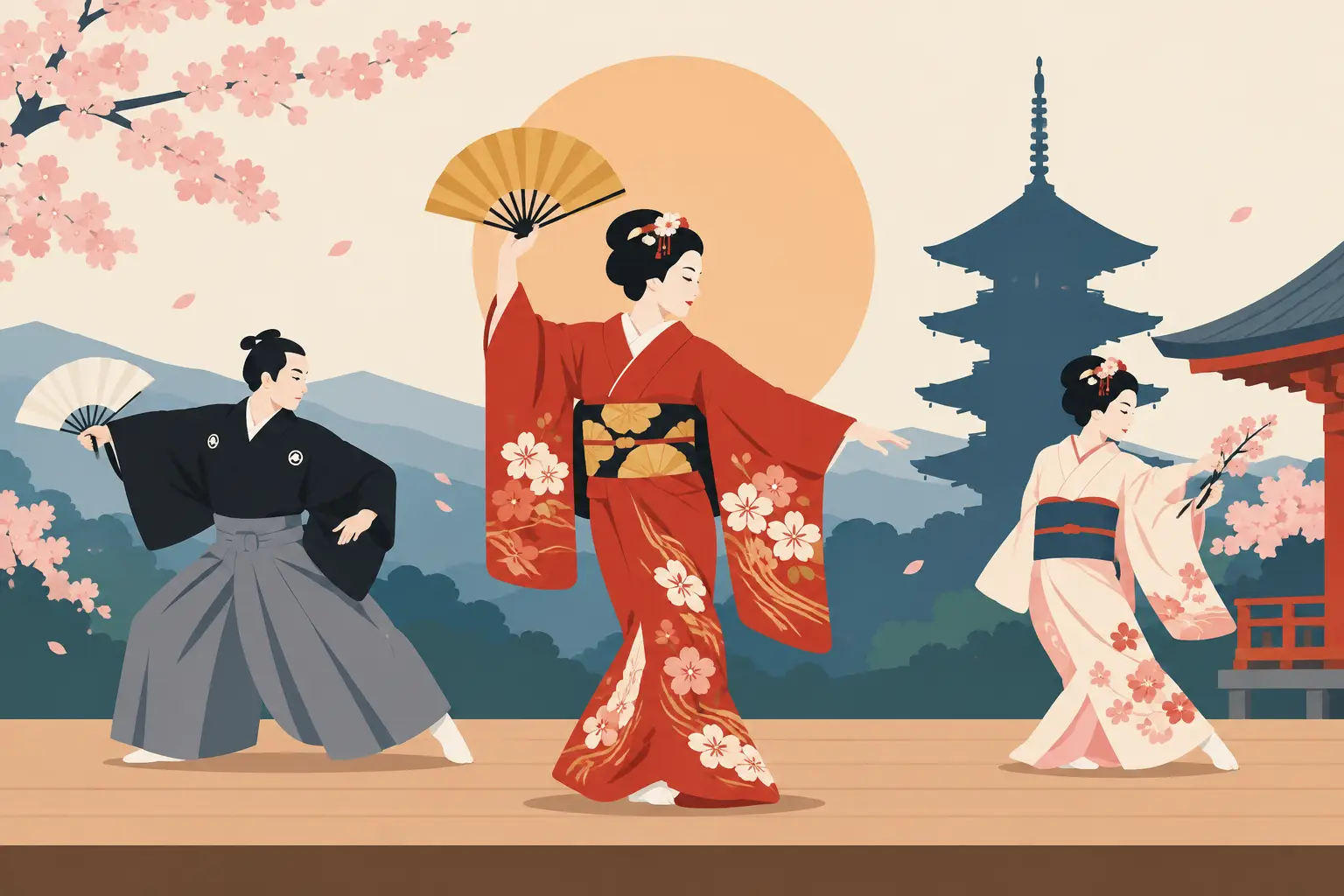
A fan opens slowly. A sleeve settles. One measured step crosses the tatami, and a room that had been quietly anticipating the performance becomes completely still. Kyoto dance performance styles are not designed to overwhelm with speed or spectacle. Their power lies in restraint: a gesture may suggest falling petals, a turning wrist may become moonlight on water, and a lowered gaze may reveal more than an expressive face.
For international guests, this refined language can feel beautifully mysterious at first. Understanding a few of its principles changes the experience. You begin to see that the dance is not simply entertainment between courses. It is a living expression of Kyoto’s seasons, poetry, music, and famously exacting sense of grace.
目次
Why Kyoto Dance Feels Different
Traditional Japanese dance is broadly known as nihon buyo, but Kyoto has its own distinct atmosphere and lineage. The city was shaped for centuries by imperial court culture, Buddhist temples, tea houses, and merchant patronage. Its dance traditions therefore favor composure, suggestion, and elegant detail over broad theatrical display.
In Kyoto’s geisha districts, performers are called geiko, while apprentices are known as maiko. Both train extensively in dance, music, etiquette, and hospitality. A dance performed by a maiko may have a youthful brightness and delicacy; a geiko’s performance often carries the mature assurance that comes from years of practice. Neither is simply decorative. Each movement has been studied, repeated, and refined until it appears effortless.
The setting matters as much as the choreography. In a private dining room, the intimacy allows guests to notice the quiet glide of the feet, the texture of the silk kimono, and the precise relationship between a dancer and the shamisen player. In a large annual theater program, the same traditions can expand into elaborate ensembles, scenery, and seasonal pageantry. These are different ways of encountering one cultural world.
Kyoto Dance Performance Styles and Their Roots
The phrase “Kyoto dance performance styles” can describe several related traditions, rather than one fixed category. The distinctions are worth knowing because Kyoto dance is often discussed too broadly, as though every performance were the same.
Kyomai: The Poise of Kyoto
Kyomai, literally Kyoto dance, is closely associated with the city’s refined aesthetic. Its movement is controlled and understated. Rather than traveling dramatically across a stage, the dancer may appear to float through a small space, creating a sense of depth with minimal motion.
The upper body is especially expressive. A fan may become a letter, a sake cup, a flower, or a drifting boat. Sleeves frame the arms in carefully measured arcs. Even stillness is active, held with intention. This makes Kyomai especially compelling in an intimate setting, where the audience can appreciate details that might be lost in a large theater.
Kyomai developed in a city attuned to courtly manners and private entertainments. Its beauty is not immediate in the way of an acrobatic performance. It asks for attention, then rewards it with quiet emotional precision.
Jiuta-mai: Dance in Conversation With Music
Jiuta-mai is another essential part of the cultural picture. It developed in the Kyoto-Osaka region and is closely connected to jiuta, a genre of shamisen music. The dance often has a contemplative quality, with movement shaped by the phrasing and atmosphere of the music.
Where a visitor may expect dance to follow a strong beat, jiuta-mai can feel more spacious. The shamisen, voice, and movement seem to breathe together. A pause is not empty. It creates tension, evokes a landscape, or gives a poetic image room to linger.
There is some overlap in the worlds of Kyomai and jiuta-mai, and the labels do not always function as neat opposites. A repertoire, school, musician, and performance context all affect what guests see. That complexity is part of the tradition’s richness. It is better to listen and watch for the relationship among dancer, music, and mood than to seek a rigid category during every piece.
Theatrical Dance and Annual Odori Programs
Kyoto’s celebrated annual dance programs, often called odori, present geiko and maiko in formal theater productions. These seasonal events may include group dances, vivid costumes, large casts, and scenes that move through local landscapes or historical imagery.
Programs such as the spring and autumn dances of Kyoto’s entertainment districts are not separate dance techniques in the same sense as Kyomai. They are grand public presentations of the arts cultivated within each district. They offer a magnificent option for travelers who want scale, color, and a formal theater atmosphere.
A private performance offers a different privilege. It is shorter and more personal, but the closeness brings its own reward. You can see the dancer’s timing with the musicians and understand why a small movement can command a room. For many guests, the choice depends on the kind of memory they want: a major seasonal production or a rare Kyoto moment shared at close range.
What to Watch for During a Performance
The easiest way to appreciate a Kyoto dance is to stop looking for a plot in the Western theatrical sense. Many dances do tell stories, but they often do so through allusion. A gesture may refer to a famous poem, a season, a character from classical literature, or the feeling of waiting for a loved one.
Watch the fan first. It is among the most expressive props in Japanese dance. Opened wide, it may suggest a landscape or a blossoming flower. Held near the face, it can create shyness or conceal emotion. Closed and used with a sharp, clean movement, it may become an object in the scene. The audience is invited to imagine the transformation.
Then notice the feet. The gliding walk is deliberately modest, particularly when worn with a formal kimono. It gives the body a centered, composed quality. The dancer’s apparent ease is the result of rigorous control, not a lack of technical difficulty.
Listen for the conversation between dance and sound. The shamisen can be crisp and rhythmic, then suddenly tender or spacious. Vocals may carry a text whose full meaning is not immediately available to an English-speaking guest, yet the emotional tone remains clear through tempo, phrasing, and gesture. An English-speaking interpreter can add context, but no explanation needs to replace the pleasure of simply watching.
Finally, look at the kimono as part of the performance. Color, pattern, and formality are rarely accidental. Seasonal motifs such as maple leaves, plum blossoms, or flowing water extend the world of the dance beyond the dancer’s body. In Kyoto, visual harmony is an art in itself.
A Few Courtesies That Deepen the Experience
Traditional dance is meant to be enjoyed, not approached with anxiety. Still, a little awareness honors the performers and makes the occasion more comfortable. Arrive on time, keep your phone silent, and wait for guidance before taking photographs or video. Photography policies differ by venue and performer, especially during an intimate entertainment.
Applause is welcome at natural pauses and at the end of a piece. If you are dining with geiko or maiko, allow the performance to hold the room rather than treating it as background activity. The attention of the audience is part of the exchange.
There is no need to understand every reference to appreciate the art. A respectful curiosity is enough. If a host or interpreter offers a brief explanation of the song, costume, or dance theme, it can make a lovely bridge into the performance without reducing it to a lesson.
Choosing the Right Kyoto Dance Experience
A theater performance is ideal for travelers planning around Kyoto’s cultural calendar and seeking the visual impact of a full production. It is public, formal, and often highly popular. Tickets may need to be arranged well in advance during peak travel seasons.
A curated private dining experience suits guests who value personal access and a more relaxed pace. At GEISHAKYOTO, Kyoto-style dining, authentic dance, traditional games, conversation, and English interpretation are brought together in one polished occasion. Higher-tier experiences may also include live shamisen, allowing guests to hear the music at the heart of the dance from only a few feet away.
Neither format is inherently better. A public odori can feel celebratory and grand; a private performance can feel intimate and deeply personal. For a honeymoon, family celebration, executive visit, or first evening in Kyoto, the latter often creates the kind of story guests carry home long after the trip.
When the final note fades, resist the urge to immediately reach for your phone. Take a moment to hold the image of the fan, the silk, and the stillness in your mind. That quiet attention is one of the most gracious ways to meet Kyoto’s performing arts.