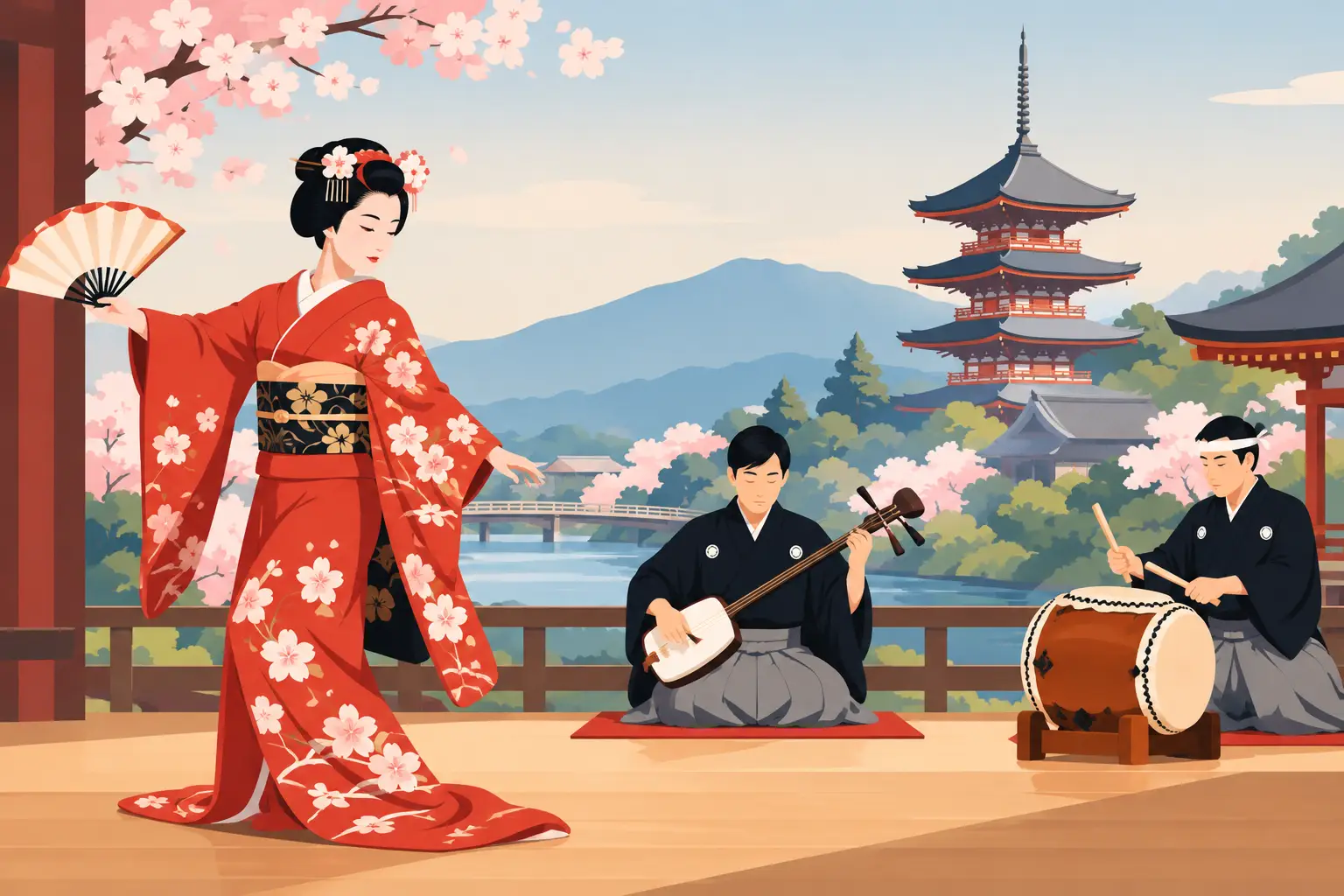
Kyoto rewards travelers who look beyond the stage curtain. The most memorable top Japanese cultural performances are not always the largest or most public. Often, they unfold in an intimate room: the measured turn of a maiko’s sleeve, the bright first note of a shamisen, or a quiet exchange over a cup of tea. For guests seeking a rare Kyoto moment, the setting, access, and quality of interpretation matter as much as the performance itself.
A performance can be beautiful without being meaningful. The experiences worth reserving offer context, skilled artists, and enough proximity to appreciate the discipline behind what you see. This is especially true for visitors with limited time in Kyoto, where centuries of living tradition can easily be mistaken for a souvenir-shop version of culture.
目次
Top Japanese Cultural Performances Worth Seeing
Geisha and Maiko Dance with Shamisen
For many international guests, an authentic encounter with geiko and maiko is the defining cultural experience of Kyoto. In Kyoto, a geisha is commonly called a geiko, while a maiko is an apprentice geiko. Their art is not simply a costume or a photograph. It is a highly trained world of dance, music, conversation, hospitality, and seasonal aesthetics.
A traditional dance may appear restrained at first glance. Every gesture, however, carries intention: the placement of a fan, the pause before a turn, the way a silk kimono changes the line of movement. Accompanied by shamisen, a three-stringed instrument with a clear, resonant sound, the performance creates an atmosphere that feels distinctly Kyoto.
The finest format is intimate rather than theatrical. A small gathering paired with a refined Kyoto meal allows guests to experience the performance at close range and enjoy the convivial side of the evening through ozashiki games. These lighthearted traditional games are part of geiko hospitality, offering a welcome contrast to the formality and grace of the dance.
Authenticity depends on who is performing, the quality of the setting, and whether guests are welcomed into a genuine cultural exchange rather than simply watching from a distance. For travelers who value clarity as well as elegance, English interpretation is invaluable. It explains the meaning behind the music and customs without interrupting the mood.
Noh and Kyogen Theater
Noh is among Japan’s oldest surviving theatrical forms. Its visual language is spare and controlled: a carved mask, a pine-tree backdrop, stylized movement, chant, flute, and drums. The result can feel almost dreamlike, particularly when a masked performer seems to shift from stillness into another emotional world with the slightest inclination of the head.
This is not a performance to approach as fast entertainment. Noh asks for patience, and its stories often draw on classical literature, spirits, memory, loss, and transformation. A program with subtitles, an English guide, or a brief introduction makes a substantial difference for first-time guests.
Kyogen, traditionally performed alongside Noh, offers a more playful counterpoint. Its comic scenes use broad physical expression and domestic situations that remain surprisingly recognizable: quarrels, vanity, clever servants, and foolish masters. If your schedule allows only one theater experience, a program that includes both Noh and Kyogen gives a fuller sense of the tradition’s range.
Gagaku Court Music and Dance
Gagaku is the ceremonial music of Japan’s imperial court, preserved for more than a millennium. Its sound is unlike the musical forms many Western visitors expect. Wind instruments sustain high, floating tones while drums establish a deliberate ceremonial pulse. When accompanied by bugaku dance, performers in vivid costumes and formal masks move with extraordinary composure.
For travelers drawn to history, ritual, and visual splendor, gagaku can be one of the most distinctive Japanese cultural performances available. It is less personal than a geiko gathering and less narrative than theater. Its appeal lies in its sense of continuity, as if a distant courtly world has briefly become visible.
Because performances are not held as frequently as other cultural programs, this is best chosen when it aligns naturally with your Kyoto dates. Do not book it simply because it is ancient. Choose it if you appreciate ceremonial art and are comfortable with a contemplative pace.
Kabuki Theater
Kabuki is vivid where Noh is spare. It brings together elaborate makeup, richly patterned costumes, dramatic poses, live music, and stories of romance, loyalty, revenge, and social obligation. The distinctive makeup, known as kumadori, makes emotion immediately legible even from a distance.
A full kabuki program can be lengthy, and the language is highly stylized. For a first visit, a single-act ticket or an accessible performance with English support is often the wiser choice. The experience is visually rewarding, but it is not necessarily the most intimate option for a special-occasion evening.
Kyoto has a historic relationship with kabuki, yet performance schedules vary. If kabuki is a priority, build your travel plan around confirmed dates rather than assuming a performance will be available during your stay.
Bunraku Puppet Theater
Bunraku, Japan’s classical puppet theater, is a remarkable display of collaborative precision. A principal puppet may require three visible puppeteers: one controlling the head and right arm, another the left arm, and a third the feet. Their coordination can make a wooden figure appear to breathe, grieve, hesitate, or fall in love.
The storytelling is carried by a narrator and shamisen player, creating a powerful relationship between voice, music, and movement. Bunraku demands attention, but its emotional force can be immediate even for guests unfamiliar with the language.
Travelers should know that the leading bunraku venue is in Osaka rather than Kyoto. It can be an excellent addition to a wider Kansai itinerary, but it may not be the best use of a short Kyoto stay. Those with only a few days in the city may prefer a performance rooted directly in Kyoto’s hanamachi culture.
How to Choose a Kyoto Performance That Feels Personal
The right choice depends on what you want to remember. A formal theater performance suits guests who want to witness a major classical art form in its established setting. An intimate geiko and maiko experience is better for those who want hospitality, conversation, music, dining, and a more personal connection to Kyoto tradition.
Before reserving, ask a few practical questions. Are the artists active professionals? Is the experience designed for a small group or a large audience? Will there be English-speaking support? Is photography permitted, and is there a respectful opportunity for a commemorative photograph? These details shape whether an evening feels polished and comfortable or confusing and impersonal.
Dining is another consideration. A performance paired with Kyoto-style cuisine can create a more complete occasion, especially for anniversaries, honeymoons, family celebrations, or private groups. It also avoids the rush of moving between dinner and a venue. The trade-off is that these carefully arranged experiences require advance reservations and command a premium price, reflecting the artists’ time, the quality of hospitality, and the limited availability.
At GEISHAKYOTO, a curated lunch experience brings these elements together through Kyoto cuisine, authentic maiko or geiko entertainment, traditional games, photo opportunities, souvenirs, and English interpretation. Higher-tier arrangements may also include live shamisen, creating a more layered encounter with the music behind the dance.
Etiquette That Lets the Art Take Center Stage
The most gracious guests arrive on time, dress neatly, and follow guidance on photography. Avoid treating performers as props or requesting intrusive personal details. A geiko or maiko is a professional artist and host, and respectful curiosity is always more welcome than assumption.
If games or conversation are included, participate warmly. You do not need to know the rules in advance, and you do not need to speak Japanese perfectly. The pleasure lies in being present, allowing the interpreter or host to guide you, and appreciating that Kyoto hospitality is often expressed through small, considered gestures.
A superb performance does more than fill an evening on an itinerary. It gives Kyoto a human scale: an artist’s practiced movement, a musician’s hand on the strings, a shared laugh across a language difference. Choose the setting that allows you to be close enough to notice those details, and the memory will stay with you long after the final bow.