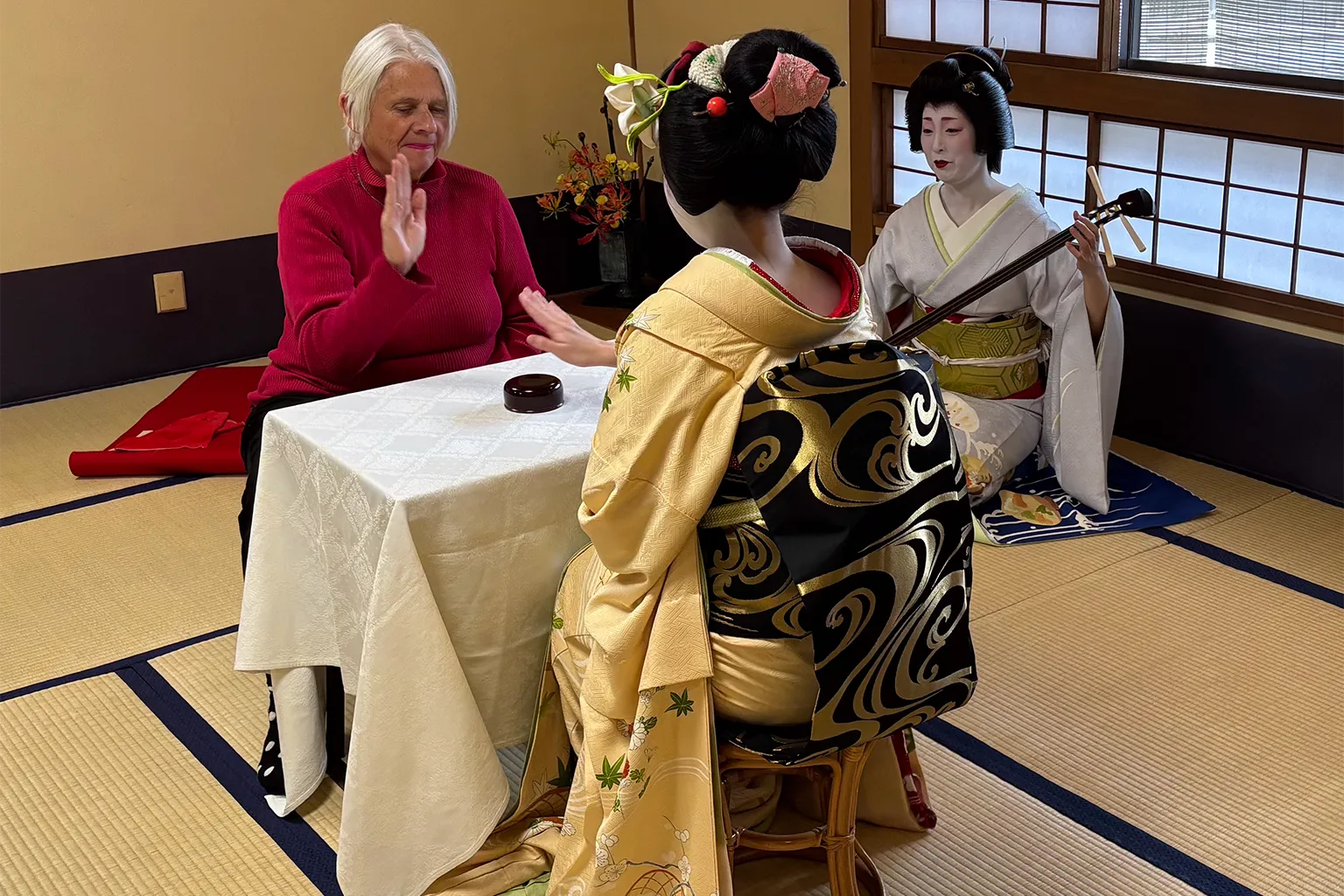
A maiko enters the room in a richly patterned kimono, her hair arranged in the traditional Kyoto style, and the atmosphere changes at once. If you are wondering what happens at a maiko luncheon, the answer is far more personal than a stage performance or a restaurant meal. It is a rare Kyoto moment where seasonal cuisine, refined entertainment, conversation, and ceremony meet at the table.
For international visitors, a thoughtfully arranged luncheon offers an accessible way into a cultural world that can otherwise feel private and difficult to approach. You are not simply watching from a distance. You are invited to share time with a maiko, enjoy the traditions of Kyoto hospitality, and leave with an experience that feels both graceful and genuinely memorable.
目次
- What Happens at a Maiko Luncheon?
- A Seasonal Kyoto Meal Sets the Tone
- Traditional Dance, Performed Up Close
- Conversation Made Comfortable for International Guests
- Games Bring a Lighter Side to the Afternoon
- Photographs and the Details You Will Remember
- Etiquette That Lets You Relax
- Why a Curated Luncheon Matters
What Happens at a Maiko Luncheon?
A maiko luncheon is a hosted daytime dining experience featuring a maiko, the apprentice entertainers of Kyoto’s historic geiko districts. While details vary by venue and package, the occasion usually combines a carefully prepared Kyoto-style meal with traditional dance, music, games, photographs, and English interpretation.
The luncheon is designed to feel relaxed rather than formal in a stiff or intimidating way. Guests are welcomed into an elegant dining setting, often a private room where the pace is unhurried and the details matter – from the presentation of the food to the timing of each performance.
It is worth understanding one distinction. In Kyoto, the fully trained artists are known as geiko, while maiko are apprentices in their years of intensive training. A maiko’s appearance is particularly recognizable: elaborate hair ornaments, long flowing kimono sleeves, and a beautifully composed style of makeup and dress. Her role at a luncheon is not to explain every part of her training, but to share the living arts of Kyoto through performance and hospitality.
A Seasonal Kyoto Meal Sets the Tone
The experience begins with dining. Kyoto cuisine is known for precision, seasonality, and restraint. Rather than one overwhelming plate, a luncheon may unfold through a sequence of beautifully presented dishes that reflect the time of year: delicate vegetables, fresh fish, tofu, rice, soup, and small seasonal accents selected for color and balance.
This is not an ordinary lunch with entertainment added afterward. The meal is part of the cultural setting. In Kyoto, hospitality is often expressed through quiet details: a dish that reflects the season, a ceramic vessel chosen for the course, or an ingredient prepared to preserve its natural character.
The exact menu depends on the venue, season, and dietary needs. Premium experiences should address dietary restrictions in advance whenever possible, particularly for guests who avoid seafood, meat, or certain ingredients. Kyoto dining traditions are nuanced, so clear advance communication is the best way to protect both comfort and authenticity.
Traditional Dance, Performed Up Close
One of the most moving moments of a maiko luncheon is the dance performance. Maiko dance is poised, controlled, and expressive. Small gestures carry meaning: a fan opening, a turn of the wrist, a lowered gaze, or the careful movement of a sleeve can suggest a season, a landscape, a love story, or a well-known scene from classical culture.
Seeing this art in an intimate room is very different from viewing a large theater production. You can notice the fine detail in the kimono, the discipline of the movement, and the concentration required to make such demanding technique appear effortless.
The performance is usually concise, which suits a luncheon setting. It offers a window into a much larger artistic tradition without turning the afternoon into a lecture. The goal is not to rush through a checklist of Kyoto customs. It is to create space for guests to appreciate a beautiful performance in the presence of the artist herself.
The Sound of Shamisen
Some higher-tier luncheons also include live shamisen. This three-stringed instrument has a crisp, resonant sound that is central to the music of the geiko districts. When played live, it gives the dance a different energy and texture than recorded accompaniment can provide.
A live shamisen performance may be especially meaningful for guests who value the craft behind the occasion. It brings together separate disciplines – dance, music, dress, and hospitality – into one distinctly Kyoto expression. Not every luncheon includes it, however, so guests who consider live music essential should confirm the specific package before reserving.
Conversation Made Comfortable for International Guests
A genuine maiko luncheon should never leave overseas guests uncertain about how to participate. English-speaking interpretation provides a gracious bridge, allowing you to understand the flow of the afternoon, ask respectful questions, and enjoy the exchange without worrying about a language barrier.
Conversation may touch on a maiko’s daily training, the traditions of her district, dance, music, or the craftsmanship of her dress. The most rewarding questions are curious and considerate. Ask about the arts she practices or what a particular performance represents, rather than treating her as a costume or a tourist attraction.
There are boundaries, as there should be. A maiko’s life and professional training are private in many respects, and the most elegant guests allow the conversation to be guided naturally. Interpretation makes this easier by helping everyone communicate with warmth and clarity.
Games Bring a Lighter Side to the Afternoon
Traditional ozashiki games are often the point where formality gives way to laughter. These games have long been part of entertaining in Kyoto’s geiko districts, creating a cheerful, social rhythm between performances and conversation.
They are usually simple to learn, even if they are not always simple to win. A maiko may demonstrate the rules, invite guests to join, and keep the mood playful. This is often the moment couples, friends, and private groups remember most clearly: the surprise of participating rather than merely observing.
The games are not meant to test your knowledge of Japanese culture. Enthusiasm matters more than perfection. Follow the host’s lead, accept a loss with good humor, and enjoy the rare pleasure of sharing a lighthearted tradition in its proper setting.
Photographs and the Details You Will Remember
A professional-style photo opportunity is a natural part of many curated luncheons. It gives guests a polished keepsake of the occasion and avoids the uncertainty of wondering whether photographs are permitted.
A posed photograph with a maiko is often more meaningful than an informal snapshot because it captures the artistry of the setting: the kimono, the room, the seasonal décor, and the quiet sense of occasion. If personal photography is allowed during other portions of the event, follow the host’s guidance. Do not photograph during a dance or private exchange unless permission has been clearly given.
Some packages also include a small souvenir. The value is not in its size, but in the connection it creates when you return home. A well-chosen memento can recall the sound of shamisen, the colors of a kimono, or the warmth of an afternoon that would be hard to recreate independently.
Etiquette That Lets You Relax
Guests do not need extensive knowledge of Japanese etiquette to enjoy a maiko luncheon. A few simple habits are enough. Arrive on time, dress neatly, listen when the host introduces the room and its customs, and let the interpreter guide the interaction when needed.
Avoid touching a maiko’s kimono, hair ornaments, or hairstyle. These are highly crafted elements of her professional appearance. When greeting her, a warm smile and a small bow are appropriate. You do not need to imitate every Japanese gesture perfectly; sincere courtesy is more valuable than performance.
If alcohol is served, enjoy it thoughtfully. A luncheon is a celebratory occasion, but it remains a refined cultural setting. The most comfortable approach is to be present, receptive, and considerate of the artist and other guests.
Why a Curated Luncheon Matters
A maiko does not simply appear on request, and authentic access to Kyoto’s traditional entertainment culture is not something visitors can reliably arrange by walking into a restaurant. The right luncheon combines trusted coordination, a suitable venue, a clear schedule, and respect for the maiko’s professional world.
That curation is what turns an unfamiliar custom into an experience you can enjoy with confidence. At GEISHAKYOTO, structured luncheon options can bring together Kyoto-style dining, dance, entertainment games, photography, souvenirs, and English support in one considered occasion.
The best way to approach a maiko luncheon is not as an item to check off in Kyoto, but as time set aside for attention. Put the phone down when the dance begins, taste the meal at its own pace, and allow the afternoon to reveal why these traditions have endured.
AUTHENTIC KYOTO EXPERIENCE